How we contributed to the company’s success via OKR Methodology



TL;DR
Qubstudio achieved 30% team growth, 75.6% NPS, and 4th place on Clutch’s Top UX Agencies in 2021—success driven by OKR methodology pioneered by Intel and Google.
3 Questions for OKRs:
- Where do I want to go? — defines objective
- How will I know I’m on track? — shows key results
- How will I get there? — defines initiatives
Key Benefits:
- Communication transparency across departments
- Rise of employee engagement through shared ownership
- Focus on key objectives via quarterly retrospectives
- Healthy competition driving maximum performance
The Article Goal: To provide you with Qubstudio’s proven OKR implementation framework, real metrics (65-80% completion sweet spot), and practical insights for driving company-wide success through goal-oriented methodology.
Looking back on 2021, we conclude it was one of the most fruitful years at Qubstudio. You may be wondering, why?
This year, our team has grown by 30%, thus deepening the company’s expertise. We have managed to raise the Net promoter score to 75.6%, which is beneficial. Qubstudio currently holds 4th place on Clutch’s list of Top User Experience (UX) Agencies.
Our extensive team continues to produce effective and meaningful work by engaging intelligent perspectives and innovative creativity. In 2021, we worked on more than 80 diverse projects and contributed to the company’s outstanding results.
I believe that our success lies in the OKR methodology. As the CEO of Qubstudio, I will dwell upon running the company and achieving more in less time using OKRs — so please read and uncover.
Connecting design decisions to measurable business outcomes is at the core of what our product analytics services enable.
A quick recap of the theory
At Qubstudio, we are sure that OKR methodology is the best way to achieve global progress-based and aspirational goals. Coming from Intel and championed in 1999 by Google, OKR (Objective Key Result) is a methodology of setting ambitious, tracked, and re-evaluated goals — usually quarterly.
As one of the best practices to manage employee and team tasks, it provides crystal-clear directions and expectations. A significant advantage of OKRs is that it raises the employee engagement percentage — a measure of success in the service business.
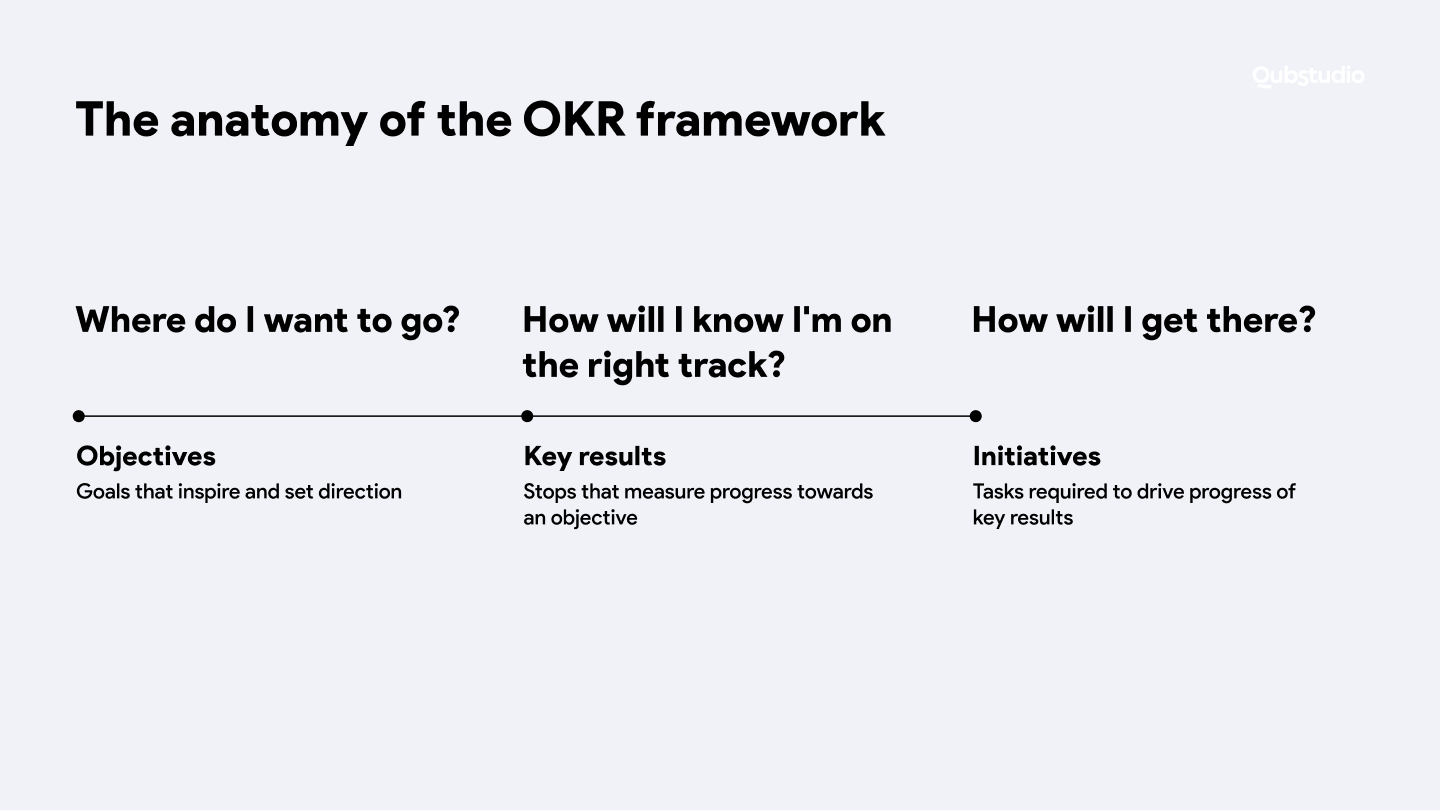
To set the goals, you need to answer three questions:
Where do I want to go? — This provides you with the objective.
How will I know I’m on the right track? — This shows you the key results.
How will I get there? — This defines your initiatives.
The next step is to prioritize your objectives according to what the business needs most. It is wise to set no more than 4 or 5 objectives, as more usually leads to over-extended teams and diffusion of effort. Be sure to pay attention to the formulation of the aims — they should be precise and measurable.
Through a thorny path to the aim: Our experience
The first pancake is always spoiled — so were the first three attempts of providing methodology in the Qubstudio environment. The challenges we faced at the beginning were:
- Too many set goals
- No structured reporting and synchronization = no responsibility
- No goal moderator = no system
When we increased our team to 50 members, we discovered there were too many messages going between departments, so we needed new tools to create more effective communication and monitor progress. Ultimately, our 4th attempt of implementing the methodology proved successful.
Though our leadership team was already aware of the methodology theory, we involved the specialist to define, set up, and implement OKRs correctly. For consulting, we chose Anna Golovchenko and, as a result — came up with three global company goals for the year. We then proceeded with onboarding the employees.
The success also lies in who is presenting. In order to be taken seriously, many innovations and changes in the company should be initiated and shared by the management team or CEO. With this in mind, our management team presented the set goals and discussed their value and the overall methodology.
Now, let’s get closer to the structuring. By this time, you may be wondering which global company goals we set as a digital design agency.
We aimed to:
- Become long-term partners, who value and use the design-driven approach
- Grow financially & professionally
- Be the best team of experts

Download our OKR spreadsheet template to set your objectives and find out how it works.
Then, all the departments defined and set their objectives within the general ones.
- Product Design & Business Analysis
- Branding Expression
- Sales
- Marketing
- HR
- Finances

As a result, each of the 6 departments contributed to the company’s success by covering their fields of responsibility. To measure progress, we use a percentage system and sum up achievements every quarter.

65-80% covered OKRs is a sweet spot. If results rise to more than 85% — the objectives were not ambitious enough. In the event that results only increase to 50% or less, then it is better to redefine the goals to more easily implemented ones.
Here is the example of 66% covered OKRs in the Product Design & BA department:

Within these quarterly objectives, the department contributed to the yearly ones. We make and share the quarterly retrospective to better measure success, track our progress, and determine if our tempo is rapid enough.
One of the Product Design department objectives was optimization & implementation of the Product Design workflow. See how it improves our work here.
OKRs: key benefits
The best part of implementing a methodology is reaping the benefits — and here are some we noticed:
-
- Communication transparency and team synchronization
We set up company objectives per year and department objectives per quarter. The departments can thus track their progress and speed up or unite to drive more remarkable results. Additionally, OKRs provide the CEO with a helicopter view — so it is easier to track how daily routine work contributes to achieving global goals.
-
-
- Rise of employee engagement rate
-
A significant portion of the entire Qubstudio team is involved in fulfilling OKRs within the employees’ competency and responsibilities. Thus, such affiliation to joint success is a strong motivator for our members.
-
-
-
- The focus on key objectives
-
-
To ensure that we keep attention on achieving crucial company goals, the departments retrospect their inputs once a quarter. Such an approach provides us with the task’s beginning and end. Also, it forms the deadline — and is there anythingmore motivating than adeadline?
-
-
-
-
- The spirit of rivalry between departments
-
-
-
A friendly competition vibe is yet another motivator. No one wants to be a loser, so departments make efforts at the maximum extent possible to complete a high percentage of OKRs.
Final thoughts
Objective Key Result methodology allows employees to interact with others, gain practical knowledge of working in different fields, and become a part of the company’s success. Generally, not only Heads of Departments are OKRs owners; members are also eager to share their input. This way, we enable our employees to grow professionally and try their strengths as managers or moderators.
At Qubstudio, driving and managing OKRs is my crucial responsibility as the CEO. I track achievements, statuses, and workload and report it to the company’s founders. As all the information about progress is filled in one table, running the company becomes greatly simplified.
The establishment of the OKR methodology at Qubstudio has enabled teams to concentrate on the big bets and accomplish more than they thought was possible. The results are visible — and it motivates us all even more.
As the OKR methodology has proved successful, now we are actively brainstorming new ambitious objectives for 2022. To keep abreast of our results — stay in touch.
Сontact us to achieve your business goals with the help of digital product design.
FAQ
What is OKR methodology?
OKR (Objective Key Result) is a methodology of setting ambitious, tracked, and re-evaluated goals—usually quarterly. It originated at Intel and was championed in 1999 by Google.
As one of the best practices to manage employee and team tasks, OKRs provide crystal-clear directions and expectations. A significant advantage is raising employee engagement percentage—a measure of success in service business.
How to set OKR goals?
To set OKRs, answer three questions: “Where do I want to go?” (provides objective), “How will I know I’m on the right track?” (shows key results), and “How will I get there?” (defines initiatives).
Aims should be precise and measurable—vague objectives lead to vague results.
How many OKRs should a company set?
Set no more than 4 or 5 objectives. More than that leads to over-extended teams and diffusion of effort.
Prioritize objectives according to what business needs most. Focused goals drive better results than scattered ambitions across too many directions.
How to measure OKR progress?
OKR progress uses a percentage system summed up every quarter. The sweet spot is 65-80% covered OKRs.
Results above 85% mean objectives weren’t ambitious enough—the team played it safe. Results at 50% or less signal goals need redefining to more achievable ones.
What challenges arise when implementing OKR?
Common implementation pitfalls cause failures:
- Too many set goals diluting focus
- No structured reporting and synchronization, meaning no responsibility
- No goal moderator, meaning no system
When teams grow past 50 members, too many messages between departments require new tools for effective communication. Initial attempts typically fail until proper structure and consulting expertise gets involved.
Who should lead OKR implementation?
Success lies in who is presenting. To be taken seriously, innovations and changes should be initiated and shared by management team or CEO—not delegated to middle managers or HR.
Top-down presentation ensures proper onboarding and serious treatment of methodology across all departments.
What are the benefits of OKR methodology?
OKR implementation delivers four key benefits:
- Communication transparency—departments track progress while leadership gets helicopter view
- Higher employee engagement—joint success creates strong motivation
- Focus on key objectives—quarterly retrospectives form deadlines
- Friendly rivalry between departments—no one wants to be last
These benefits compound as teams internalize the methodology.
What are examples of company-level OKR goals?
Strong company-level OKRs balance ambition with measurability. Qubstudio’s three global goals demonstrate this:
- Become long-term partners using design-driven approach
- Grow financially and professionally
- Be the best team of experts
These broad objectives cascade down—departments define their own contributions. The Product Design & BA team achieved 66% covered OKRs in one quarter, within the optimal range.